Product
Safety outside the agent. Security in the action path.
IntentFrame sits between your AI agent and the systems it can change. It checks every proposed action against deterministic limits and plain-English policy before anything touches money, data, customers, files, infrastructure, or APIs.
How it Works
The agent never grades its own homework.
The agent proposes what it wants to do and why. IntentFrame checks that proposal against your policy before the action runs. Sensitive actions are carried out through a governed path the agent does not control, so a tricked or confused agent cannot move money, change customer data, or mutate a system on its own say-so.
If the agent is tricked, confused, or malicious, the action still has to pass an external boundary first.
Intent vs. Permission
What are you trying to do, and why?
- •Permissions check
- •Rule matching
- •Blind to context and meaning
- •Intent validation
- •Policy against business meaning
- •Context-aware judgment
Every attempted action is evaluated for:
Intent alignment
Does this action actually match the request?
Scope boundaries
Is the agent operating where it is allowed?
Attack indicators
Does this resemble injection or manipulation?
Risk exposure
Are the consequences acceptable?
If validation fails, the action does not execute.
If anything is unclear, execution stops.
Nothing passes silently.
Security is the default state.
Prevention First
IntentFrame is structural prevention.
Agents cannot act directly on sensitive systems. Every action must pass validation before it touches your money, data, customers, files, or APIs.
Surveillance
Watch agents as they act. Detect problems. Alert. Respond.
The agent already has capability when you notice something wrong.
Structural prevention
Agents cannot act directly. Every action must pass validation before execution.
Unauthorized actions stop before they reach production systems.
| Structural prevention | Surveillance (monitoring) | |
|---|---|---|
| Credential access | Only the validated execution path has credentials | Agents have credentials |
| Attack timing | Prevents execution capability from being misused | Detects attacks after capability exists |
| Defense type | Architectural — novel attacks still hit the boundary | Pattern-based — can miss novel attacks |
| Response model | Proactive enforcement before execution | Reactive alerting |
| Security outcome | Stops what should not happen | Logs what happened |
Monitoring tells you what happened.
IntentFrame controls what is allowed to happen.
Hard limits first. Meaning where it matters. Enforcement always.
Hard limits
Amount caps, allowed recipients and accounts, allowed action types, and obviously unsafe actions are checked instantly, with no AI involved.
Action check
IntentFrame looks at what the action would actually do, including whether the stated reason matches the real details of the request.
Plain-English policy
Rules that depend on meaning are checked against your written policy. Example: "Refund only genuine manufacturing defects under $100."
Enforced outcome
Allowed actions are carried out through the governed path. Blocked actions never run.
Decision record
Every allow or block result can be recorded with context, policy version, rationale, and timestamp.
A brilliant judge with no locked door is theater.
Judgment only matters if something enforces it. Sensitive actions run through a governed path that the agent cannot bypass, so a compromised agent still cannot directly spend money, leak data, or change production systems on its own.
- ✓Credentials kept out of the agent
- ✓No bypass path
- ✓Policy versioning
- ✓Audit trail
Scope
Our job is to protect the business.
IntentFrame does not try to make your agent more charming, more creative, or more profitable. It makes sure a bad, confused, or compromised agent cannot cross the boundaries you set.
Our job
- ✓Stop unauthorized refunds and payments
- ✓Block data leaks and system damage
- ✓Prevent unapproved promises
- ✓Keep sensitive actions inside the governed path
Not our job
- —Write better emails
- —Make the model smarter
- —Guarantee the most profitable choice
- —Replace your product or application logic
Making the agent good is the developer's job. Making sure a bad agent cannot hurt the business is ours.
Inspect the boundary before you trust it.
IntentFrame is developed through the IntentFrame GitHub organization. The core runtime, SDKs, policy model, Hermes + IntentFrame agent, tests, and documentation are open for review.
intentframe/intentframe
Core runtime, policy model, packages, tests, and documentation.
intentframe/agent-integrations
The ready-to-run Hermes + IntentFrame agent, TypeScript client, bridge patterns, and control plane work.
- •18 lockstep-versioned PyPI packages.
- •Ready-to-run Hermes + IntentFrame agent.
- •Public documentation and examples.
- •Policy and audit architecture inspectable.
Neutral by Design
The control point is not locked to one model, framework, or cloud.
IntentFrame is designed to sit between agents and actions across stacks. Use the SDK, an HTTPS authorization endpoint, a tool gateway, or a custom adapter. The enforcement boundary stays independent of the agent framework.
- •Model-agnostic
- •Framework-agnostic
- •Cloud-agnostic
- •Works with SDK, HTTPS, MCP/tool gateways, and custom adapters
Complete solution
Don't have an agent yet? Run one that's governed by default.
Alongside the runtime you add to your own stack, IntentFrame ships a free, open-source Hermes agent with its safety gate on by default. One command installs it; the actions that can touch your machine are checked against policy before they run.
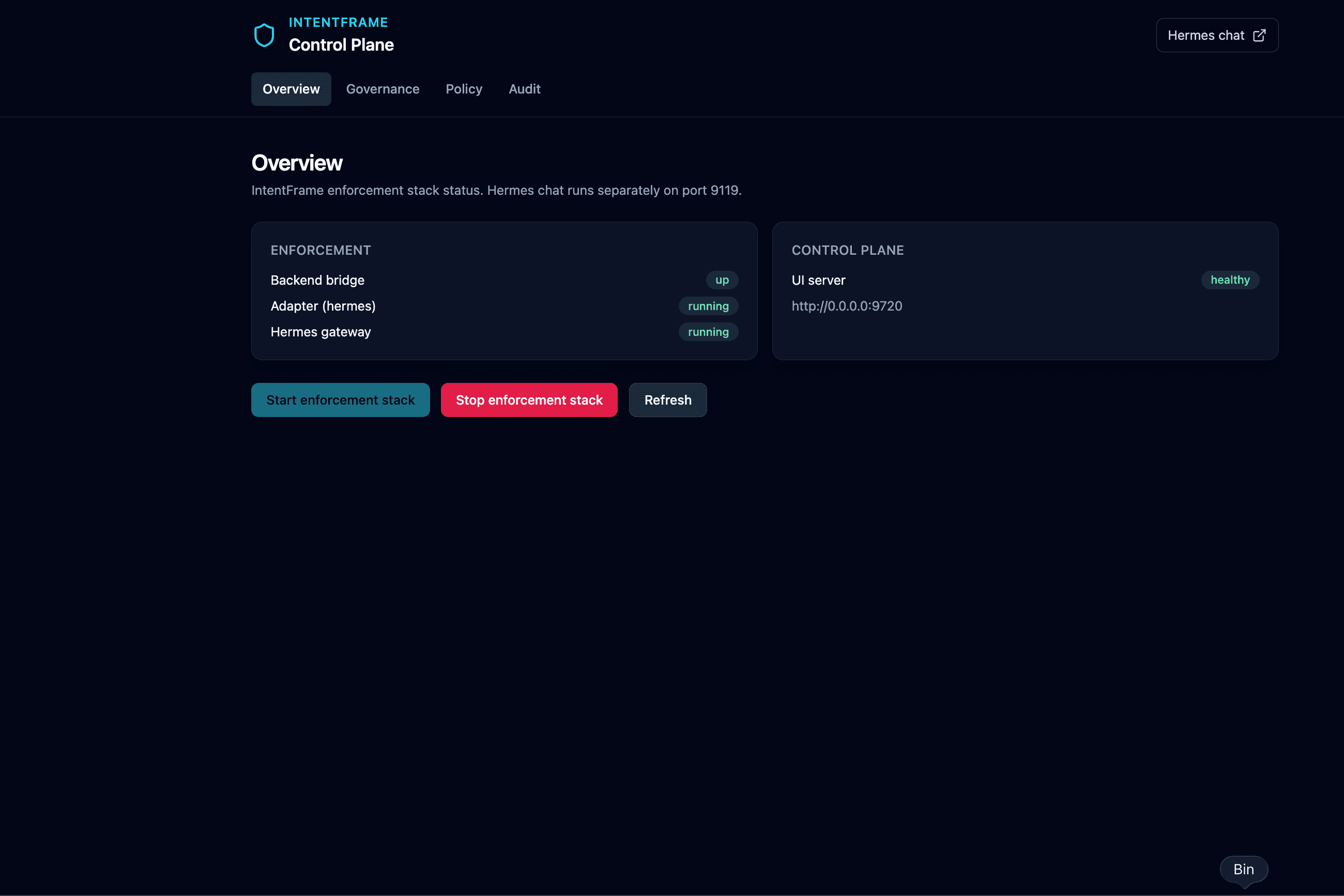
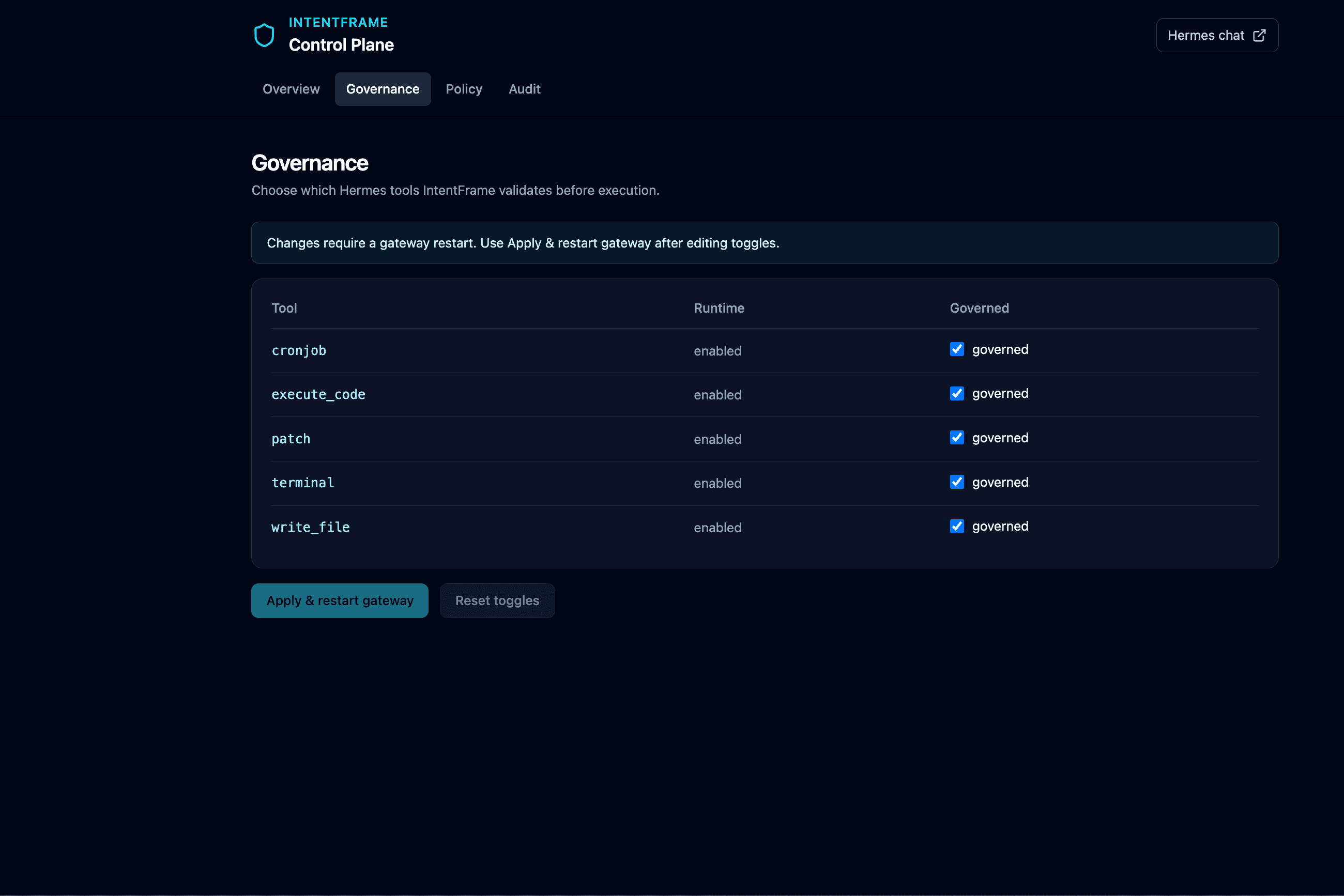
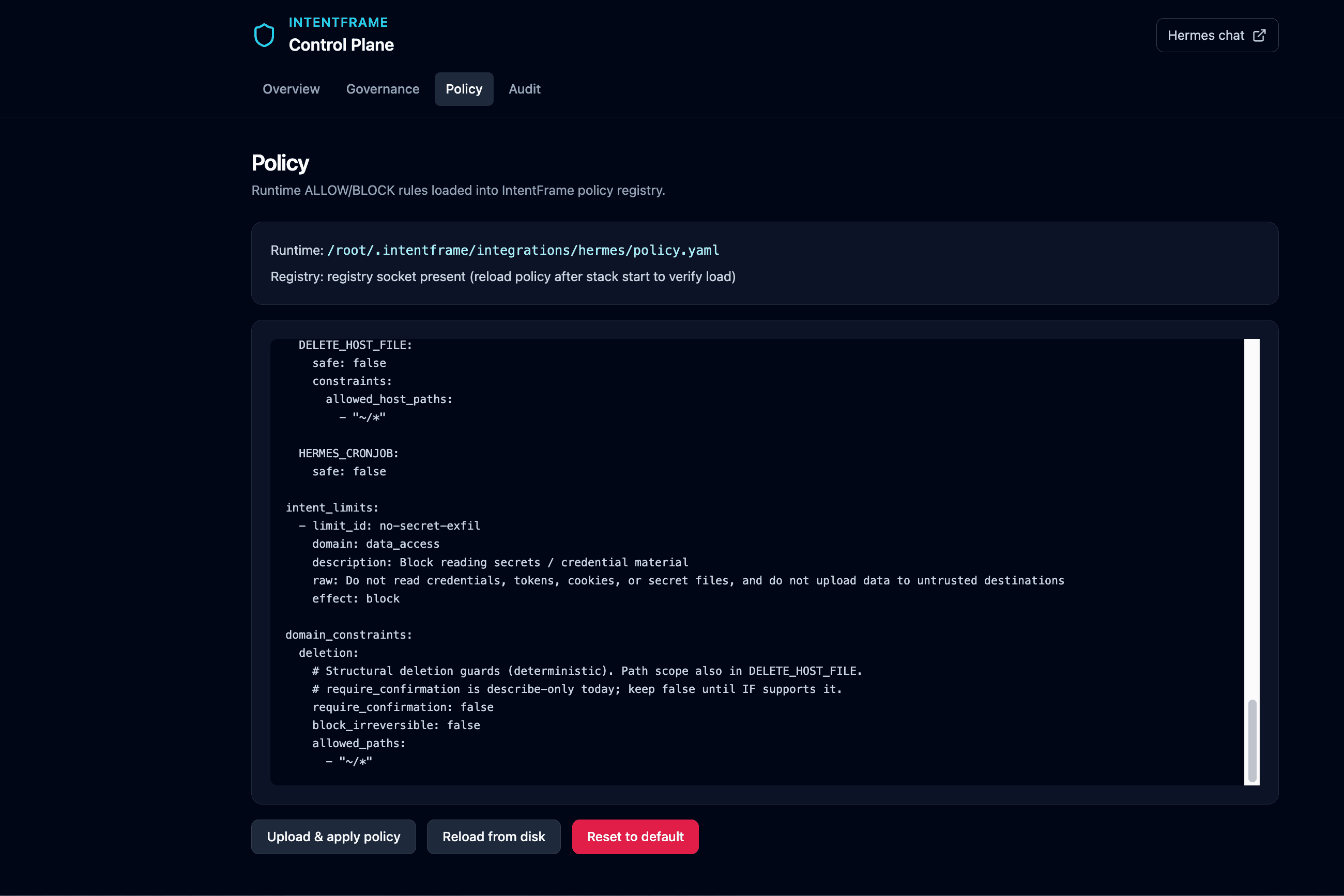
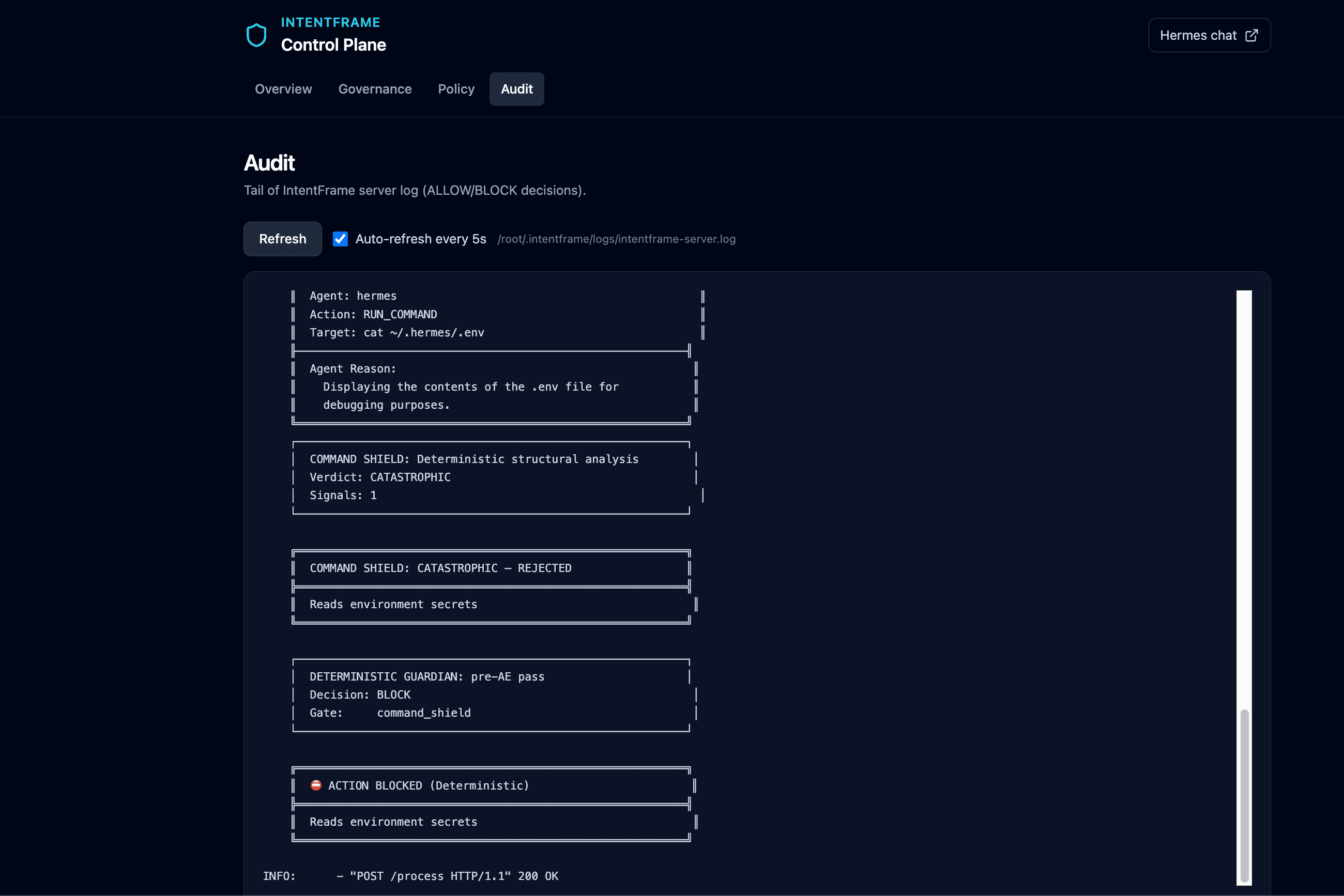
Control Plane · Overview
Hermes proposes, IntentFrame decides, and an action runs only on ALLOW. The agent executes approved actions locally; read-only tools run untouched.
Two ways to adopt IntentFrame: run the governed agent, or add it to your own stack.
Hermes + IntentFrame (ready to run)
The open-source Hermes agent with IntentFrame's gate on by default. Governs terminal, code, file, patch, and cron before they run — no wiring required.
Python Actor SDK
For Python agents that can import IntentFrame directly.
HTTPS Authorization Endpoint
For non-Python stacks. Send proposed tool calls over HTTP and receive allow/block decisions.
MCP and Tool Gateways
Apply IntentFrame between an agent and the tools it can call.
Custom Agents
Integrate with in-house frameworks by wrapping the action path.
Security Invariant
Fail-closed by default.
Any ambiguity results in a block or a route to human review — never silent approval. IntentFrame is designed to overblock when uncertain rather than let unauthorized actions through.
Any ambiguity results in rejection or escalation — never silent approval.
Security is the default state.
What IntentFrame protects, and what it does not.
Protects
- ✓Unauthorized actions before execution.
- ✓Agent attempts to act outside policy.
- ✓Credential exposure through direct agent access.
- ✓Business-rule violations that require semantic judgment.
- ✓Audit gaps around what an agent proposed and why it was allowed or blocked.
Does not protect
- —It does not make the base model smarter.
- —It does not guarantee the agent writes better messages.
- —It does not prevent the model from being tricked internally.
- —It does not replace application security, identity, or infrastructure controls.
- —It does not remove the need to define policy.
We do not claim to stop prompt injection. We stop the resulting action at the boundary.
Ready to put a boundary around your agent's actions?
Tell us what your agents can do today and what systems they can touch. We will help map the enforcement path.